Posts

#7 Water

Image
This entry took me longer to write than I hoped. Spring and summer here means there is a lot of work in a short time, and that leads to other things being placed on the back-burner. Writing was one of them... Water: everyone takes it for granted. It is a key resource to have access to when going off-grid. In many ways, it's more important than electricity. I know that there are several methods to become independent of the public water works, but only a few of those make real practical sense in a northern climate. In addition, water doesn't just entail the clear stuff for drinking, washing and cooking: wastewater is equally important to deal with correctly so that it doesn't negatively impact your little piece of heaven in the long run.  Sources of water One of the popular ways to become independent of the public water supply is rain catchment. A lot of popular off-grid YouTubers use this method, think of Life Uncontained , Green Dream Project , and others. The problems with...

#6 Heating Systems

Image
In a cold climate, effective and efficient heating systems are paramount. Because I'm off-grid, I also want a heating system that is fail safe, that is, at least one of the heating options has to be chosen so that it works even if there is no power at all. I wanted at least a couple of systems that work well together, and provide a level of redundancy. We have a couple of options to work with; I will discuss both the advantages and disadvantages.  Before I get to that though, we need to have some idea of how much heating we're going to need. This will determine the size of the heating system, how long they can work between firing/charging sessions. This is going to involve some math - math is good! Heating losses What determines the size (in terms of power and stored energy) of the heating system is essentially one thing: heating losses. If there would be no losses at all, you'd heat up the place once and you're done. This is of course not realistic. Heating losses are ...

#5 Let's Make Electricity - Part 2: Components and Costs

Image
In part one I analyzed the electricity requirements, so now let's start putting this in terms of components, and what it all costs. The components that make up the entire system are: the solar panels, the battery, solar charge controller and the inverter (to make 230V AC). My goal for this system was to do it as cost effective as possible. Note: I said cost effective, not cheapest. I wanted to make sure that the equipment could handle the needs, and could deal with the power I wanted without under-sizing or cutting costs when it comes to safety or reliability. What I didn't want to do was just to run out and buy Victron or Schneider equipment, maybe with SimpliPhi batteries and call it a day. With that said, I also realize that the options I went for are not necessarily feasible for everyone. In the mean time other some options have become available that are more readily accessible for everyone (especially when it comes to batteries) so I will mention those as well. This blog ...

#4 Let's Make Electricity - Part 1: Sizing the System

Image
When someone mentions off-grid, one of the first things that come to mind is not being connected to the electricity grid so it deserves some extra attention. This is probably going to be the longest and most involved blog entry I'm writing in the entire series, and I will have to split it into two parts. The reasons for this are the overall scope of the topic, ranging from solar panels, batteries, the choices to be made and how much it costs. It can be quite an involved and very technical process. Starting with power audits and analyzing current and future demands, this usually leads to an outcome that is different for everyone.  I'm going to try and build this up from the bottom and show you the decision process involved. This process, independent of actual end result, is the same for practically any off-grid situation. In contrast to my other blog entries, I'm going to provide links to calculation tools, hardware, and so on. I'll try to present both the way I did it (...

#3 The Foundation

Image
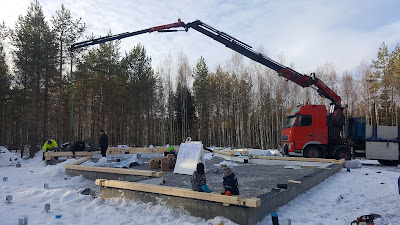
In many countries the foundation of a house is a matter of pouring a slab of concrete on grade, or putting up some pillars, and calling it a day. Here in Finland, the latter is popular for summer cottages that are not year round in use, since it is a low cost and effective way to build a foundation for buildings that don't have strict requirements for winter. Slab on grade is often used in warmer climates, but even there insulation of the slab is becoming more important to prevent energy losses through the floor.  The end result, with the first logs being placed. You can imagine that in a cold climate, I need a foundation that not only is designed to hold up the house, but one that is engineered to prevent heat losses as much as possible, and one that is built in such a way so that any water is drained away from the foundation itself. Having water in contact with the foundation is not only problematic for moisture coming up through the foundation, successive freeze/thaw cycles woul...