Posts

#4 Let's Make Electricity - Part 1: Sizing the System

Image
When someone mentions off-grid, one of the first things that come to mind is not being connected to the electricity grid so it deserves some extra attention. This is probably going to be the longest and most involved blog entry I'm writing in the entire series, and I will have to split it into two parts. The reasons for this are the overall scope of the topic, ranging from solar panels, batteries, the choices to be made and how much it costs. It can be quite an involved and very technical process. Starting with power audits and analyzing current and future demands, this usually leads to an outcome that is different for everyone.  I'm going to try and build this up from the bottom and show you the decision process involved. This process, independent of actual end result, is the same for practically any off-grid situation. In contrast to my other blog entries, I'm going to provide links to calculation tools, hardware, and so on. I'll try to present both the way I did it (...
#3 The Foundation

Image
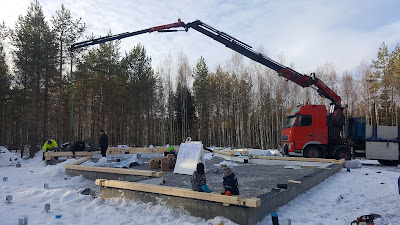
In many countries the foundation of a house is a matter of pouring a slab of concrete on grade, or putting up some pillars, and calling it a day. Here in Finland, the latter is popular for summer cottages that are not year round in use, since it is a low cost and effective way to build a foundation for buildings that don't have strict requirements for winter. Slab on grade is often used in warmer climates, but even there insulation of the slab is becoming more important to prevent energy losses through the floor.  The end result, with the first logs being placed. You can imagine that in a cold climate, I need a foundation that not only is designed to hold up the house, but one that is engineered to prevent heat losses as much as possible, and one that is built in such a way so that any water is drained away from the foundation itself. Having water in contact with the foundation is not only problematic for moisture coming up through the foundation, successive freeze/thaw cycles woul...

#2 The House: Core Design Decisions

Image
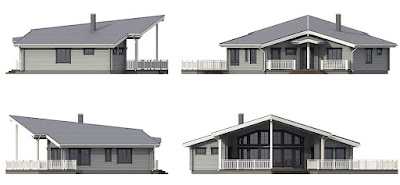
Before I began writing this text, I asked for some feedback on the previous posts. One of the things that has become clear to me thanks to the feedback is that I've been writing too many scientific papers: whereas these are full of passive voice, this might not be the best for a blog. I didn't realize I was doing that until it was pointed out to me: thanks for that! Therefor, I'm going to try to change - starting with this entry - let's see if it works out... It took some time to get to this... When I started this project I often thought about what the house would look like in the end. The only thing I knew for sure was that it would be a log house. But what kind of log house? How big did I really want it to be? Would it be on one or two levels? With an attic? Maybe an A-Frame? And a log is a log, right? Initial thoughts The first thing I started to ask myself was: how much space do we really need for our family of four? In a cold climate, the smaller the place, the eas...

#1 Location, location, location

Image
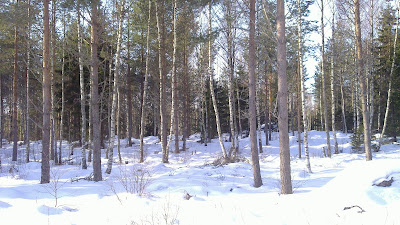
After having compiled a wish-list and a set of goals, the next step in the adventure is trying to find the right plot of land to build on. Take your time with this. It took me around five years to find the right spot. Taking hasty decisions during this process makes it just more regrettable when you come to the conclusion you made the wrong choice. During the search, you can also use the time available to flesh out the details on the building itself, the power system, etc. - all things you won't have time for once you start the building process.

#0 The Goals

Image
The first general step towards building any kind of off-grid place anywhere, is to set out the goals you want to achieve, and formulate why you want to achieve them, and the difficulties and challenges you anticipate in how to achieve them. It is important to identify potential issues early on so you can plan to tackle them in time (and budget for them appropriately). You will have to make concessions at some point, and that's ok - just make sure you anticipate these in advance.  

And in the beginning...

Image
 ... there was an idea. The idea to build a modern, comfortable, family home - off grid, in Finland. It took many years developing this idea into something that was realistically possible. Technological advancements have recently reached the point where it is, and in a cost effective way.